Accelerating CoPilot Adoption
Change Enablement | AI Adoption | Employee Experience
This case demonstrates how change strategy and storytelling supported an enterprise AI rollout by addressing adoption at the cultural level, shifting employee mindsets toward curiosity and experimentation.
The organization had invested heavily in AI, but many employees were unsure how it fit into their daily work.
Leadership Mandate vs. Employee Readiness
A global specialty insurance organization introduced Copilot as part of a leadership initiative to accelerate AI adoption and strengthen its long-term competitiveness. While training resources and technical access were in place, early signals suggested many employees were unsure how the tool fit into their daily work.
Natural Skepticism Toward Workflow Change
From an employee perspective, Copilot felt new, abstract, and disruptive. Many questioned why they should change routines that were already working, particularly when the benefits of AI had not yet become tangible, reflecting a common behavioral pattern: people are unlikely to change established habits until they clearly see the value.
Business and Strategic Risk
For leadership, low adoption represented more than a technology challenge. It risked limiting the return on a significant investment and slowing progress toward a broader goal of positioning the organization as an innovation leader in the future of insurance.
Addressing adoption required shifting how employees understood and experienced AI in their daily work
Broad Audience, Targeted Focus
While Copilot was deployed enterprise-wide, the primary behavioral focus was on late adopters. These individuals were not opposed to innovation; they simply needed clearer signals that the tool could meaningfully support their work.
Emotional and Cultural Barriers
Insights were synthesized from Copilot usage analytics, employee survey data, and qualitative feedback from managers.
The core friction was not technical but psychological. Amid a broader organizational push toward AI, many employees experienced change fatigue. For adoption to grow, employees needed to see AI not as another disruption, but as a tool that could augment their expertise.
Tone as a Strategic Constraint
AI messaging required deliberate tone sensitivity. Communications needed to feel authentic, human, and grounded in real employee experiences, avoiding overly polished corporate messaging that could erode trust.
The opportunity was to help employees see Copilot as a practical tool for their daily work, shifting perception from uncertainty to curiosity and enabling broader experimentation with AI.
The change strategy positioned storytelling as the primary lever to shift mindset and behavior.
Storytelling as a Behavioral Intervention
The campaign centered on making AI visible and relatable. Adoption would not accelerate through technical enablement alone; employees needed to see colleagues using Copilot in practical, meaningful ways. Real stories helped translate an abstract technology into something recognizable and relevant to daily workflows.
Two guiding principles shaped the approach:
Celebrate the human side of AI: Highlight real employees integrating Copilot into real workflows.
Reinforce progress, not perfection: Normalize experimentation and learning to lower the psychological barrier to entry.
Peer-Driven Social Proof
The campaign emphasized peer visibility across levels. Stories featured employees describing how Copilot helped them “take back bandwidth” or simplify routine tasks. Participants were lightly guided but not scripted, preserving authenticity.
This visibility created powerful social proof. When employees saw colleagues successfully experimenting with AI, the shift became more approachable: If someone like me can use this, I can too.
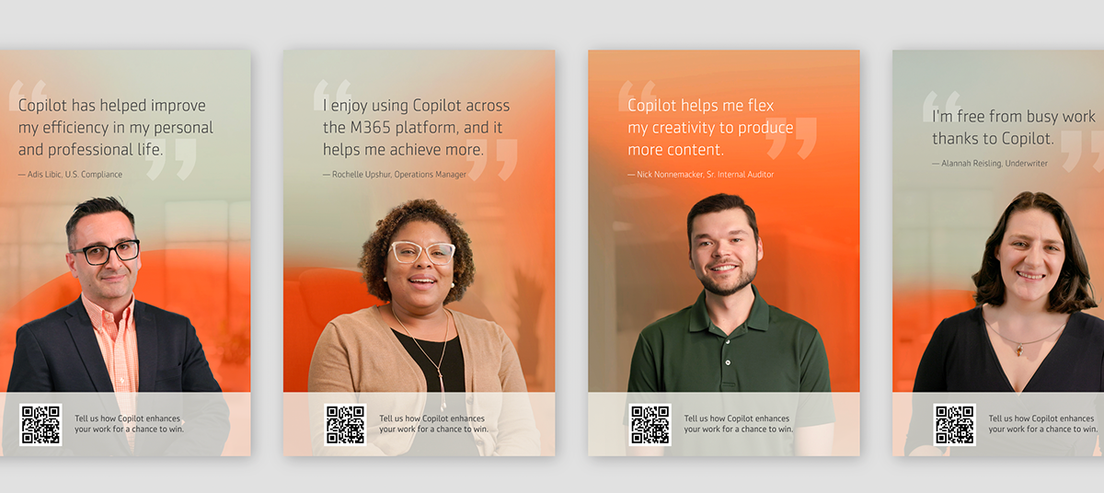
The solution was delivered as a multi-channel campaign with each component reinforcing the same message: AI is already helping your peers, and you’re invited to explore it too.
Story-Driven Video
A flagship video launched the campaign, featuring employees across roles and levels—including managers and executive leaders. Participants shared authentic, unscripted examples of how they were using Copilot in their daily work, helping to translate an abstract technology into practical, relatable use cases.
Multi-Channel Campaign Execution
The campaign rolled out across multiple channels to reinforce visibility and consistency. Branded emails introduced key messages pointing to a central SharePoint hub housing stories and resources. Digital signage in corporate offices extended the reach, embedding the message into everyday environments.
Ongoing Participation Loop
Employees were invited to respond to: “How does Copilot help me take back my bandwidth?” Selected submissions were featured in newsletters and on digital signage, creating a visible feedback loop that sustained momentum and normalized experimentation.
Employee participation indicated meaningful behavioral and cultural traction. Strong engagement with the submission prompts led to a growing pipeline of AI stories, reinforcing Copilot's visibility across the organization.
The leadership response was equally positive, with the campaign recognized as an effective model for sustaining AI awareness and engagement.