Streamlining Account Onboarding
Learning & Enablement | Adoption & Experience
This case demonstrates how thoughtful onboarding design can accelerate time-to-confidence, reduce team friction, and protect the client experience during rapid account growth.
At a Glance
- Client
- Regional Financial Services Institution
- Role
- Change Enablement Specialist
- Timeframe
- 4 months
Rapid account growth outpaced the onboarding experience needed to support consultants in delivering value quickly.
Growth Without Onboarding Infrastructure
This work emerged organically while embedded on a new client account that scaled quickly from a core team of seven to more than 30 people. In a consulting environment, new team members are expected to ramp up quickly and contribute value to the client almost immediately. However, as the team expanded, onboarding became a pain point for the full team, with no formal process or centralized place for new team members to learn about the client.
New Hire Experience and Team Impact
New hires relied heavily on tribal knowledge, scattered folders, and ad hoc conversations to get up to speed. In consulting environments where speed and confidence are critical, this lack of clarity slowed ramp-up and time to confidence. At the same time, onboarding leads and managers faced a growing burden of repeated questions and one-off meetings, pulling time away from delivery work.
Operational and Client Risk
These challenges risked slowing ramp-up and creating unnecessary strain on the broader team, increasing the likelihood of misalignment and uneven client delivery.
New team members needed clear, reliable pathways to build confidence quickly, while the team needed a more scalable way to support onboarding.
High Dependence and Repeated Friction
The primary audiences included new team members joining the account and the onboarding leads responsible for supporting their ramp-up. Through real-time observation and conversations, a consistent pattern emerged: new hires were highly dependent on others for even basic information. Questions were frequently repeated in team channels, and onboarding leads spent significant time responding to similar requests.
Information Was Available, but Not Usable
Critical documents and templates were technically available but difficult to locate, scattered across channels and folders. As a result, new team members struggled to find what they needed to ramp up. In environments like this, the challenge is not a lack of information but a lack of clarity and structure, making it difficult for consultants to quickly build the context needed to engage effectively with the client.
Designing Within Practical Constraints
Insights were gathered through conversations with new hires, observing onboarding in real time, and monitoring patterns in team channels. A key constraint was the need to work within SharePoint’s capabilities, requiring a solution that was scalable and easy to maintain as the account grew and onboarding roles shifted.
The opportunity was to create a centralized, intuitive onboarding experience that accelerated time-to-confidence for new team members, improving team efficiency.
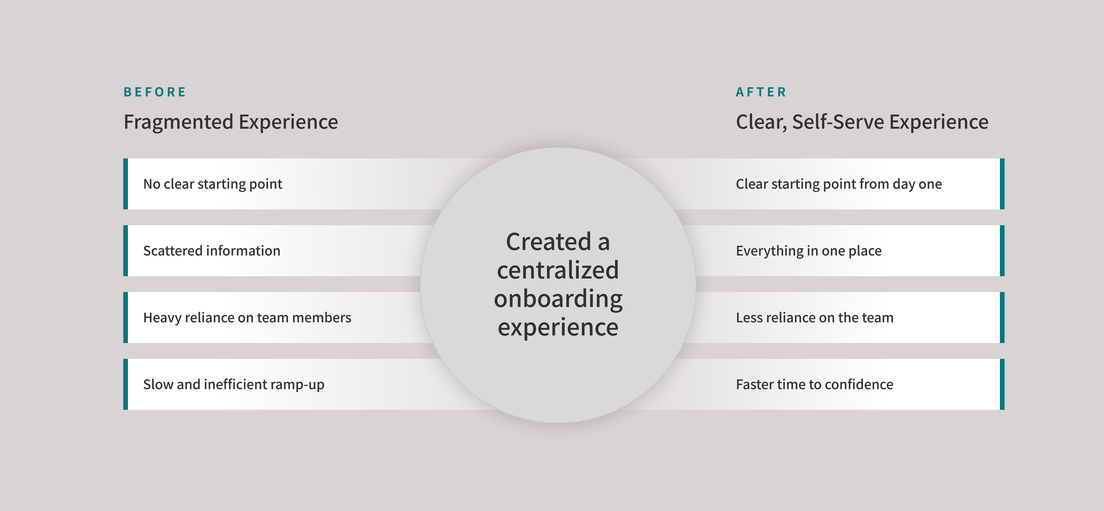
Onboarding was treated as a critical driver of delivery, reducing friction and enabling faster contributions to client work.
Accelerating Time-to-Value
New team members were entering an environment with high uncertainty, low context, and immediate expectations to contribute. In consulting, onboarding is not just about orientation; it also affects how quickly someone can deliver value to the client. The strategy focused on reducing cognitive load and creating clear, structured pathways that would help new hires build confidence quickly and engage effectively with their work.
Guiding Principles for a Scalable Experience
The approach centered on making onboarding self-serve but supported, centralizing information into a single source of truth. By prioritizing clarity and accessibility, the goal was to enable new team members to find what they needed independently while still feeling supported by the broader team.
Collaborative and Iterative Development
The solution was developed in collaboration with onboarding team members and content SMEs, who provided input on essential materials and common pain points. An MVP was introduced during an all-hands meeting, with feedback used to inform future iterations.
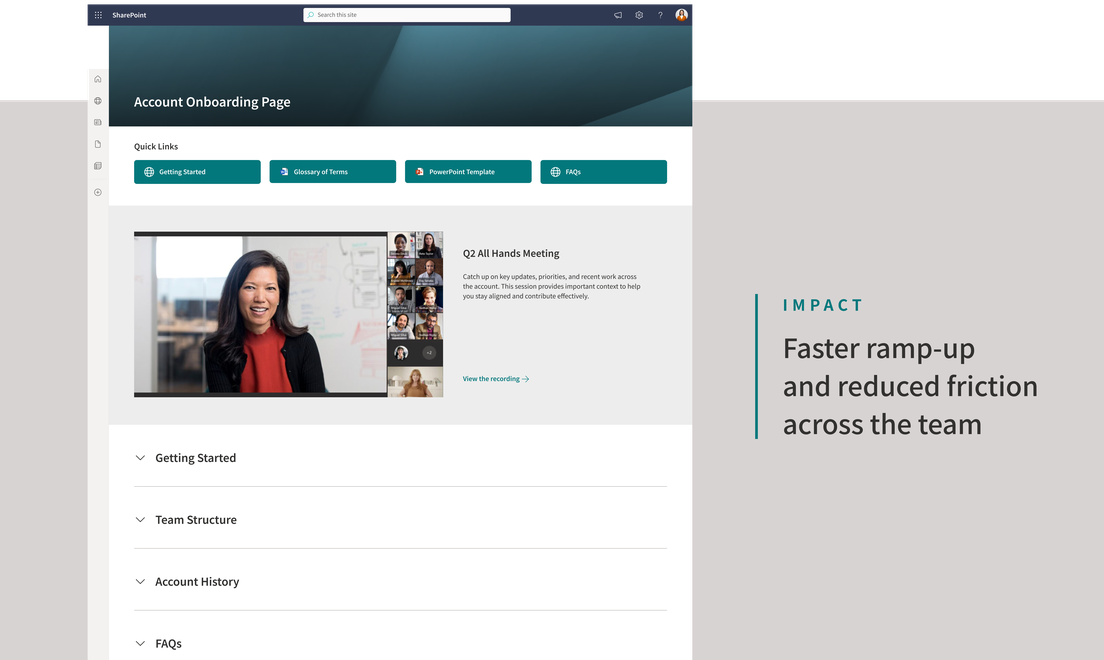
The solution combined a centralized onboarding hub with a structured onboarding process designed to reduce dependency and accelerate ramp-up.
Centralized Onboarding Hub
The onboarding hub served as a single destination for all critical account information, consolidating resources that had previously been scattered across folders and conversations. It included orientation materials, client background and industry context, templates, past deliverables, team norms, and a living Q&A to address common questions.
Content was organized by topic, allowing new team members to either scan for a high-level understanding or quickly find the specific information they needed. This structure reduced reliance on ad hoc support and enabled a more self-serve onboarding experience, helping consultants build context, confidence, and independence more quickly.
Onboarding became more structured, predictable, and easier to navigate for new team members.
New hires were able to ramp up faster and contribute more quickly to client work, improving overall team efficiency and client delivery.
The solution delivered sustained value and became the standard onboarding approach for the account, demonstrating its scalability and long-term impact.